
Mushroom coffee seems to be everywhere lately. What started as a niche wellness drink has quickly become a popular alternative to traditional coffee, with brands claiming benefits ranging from better concentration and more energy to improved metabolism and weight management.
Naturally, this raises an important question: does mushroom coffee help you lose weight?
After looking closely at the available medical and nutritional research, the answer is not as dramatic as many advertisements make it sound. Mushroom coffee is not a proven fat-burning drink, and there is currently no strong evidence showing that drinking it alone leads to meaningful weight loss.
However, that doesn’t necessarily mean it has no place in a healthy weight-loss routine.
Certain ingredients in mushroom coffee, particularly caffeine and extracts from mushrooms such as cordyceps, lion’s mane, reishi and chaga, contain compounds that researchers are studying for their potential effects on metabolism, energy, stress and overall health.
So, let’s separate the promising science from the marketing hype.
What Exactly Is Mushroom Coffee?
The name can be slightly misleading. Mushroom coffee doesn’t usually mean regular mushrooms floating around in your morning cup.
Instead, manufacturers typically dry medicinal or functional mushrooms, extract or grind them into a powder, and combine that with coffee. Some products use instant coffee, while others are sold as ground coffee, pods or powdered drink mixes.
The mushrooms most commonly used include:
- Lion’s mane
- Cordyceps
- Reishi
- Chaga
- Turkey tail
- King trumpet
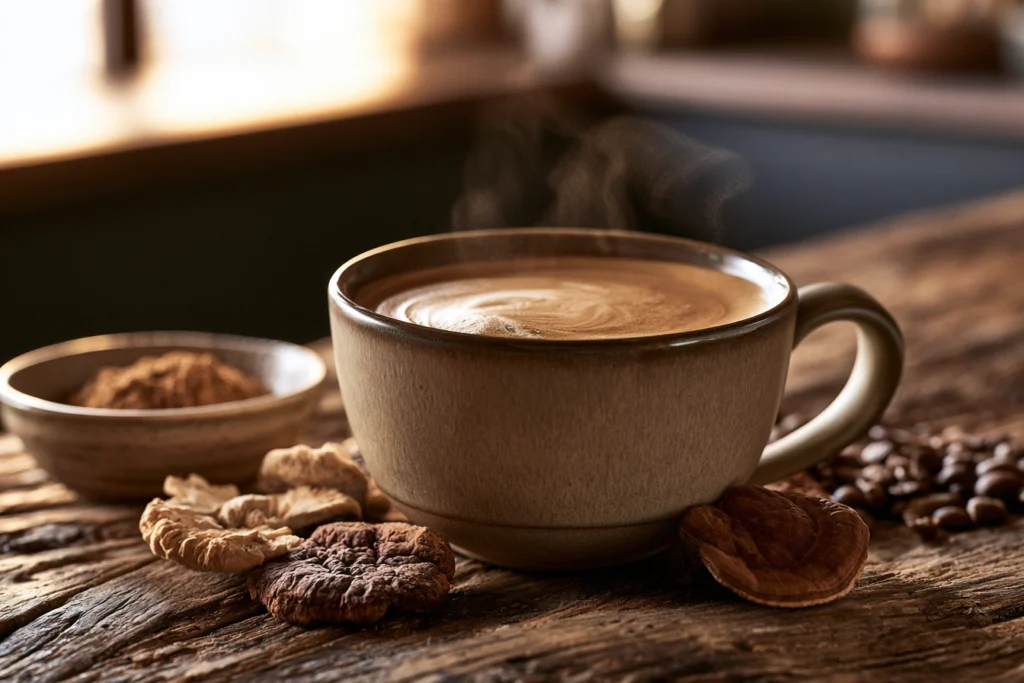
Each mushroom contains a different combination of bioactive compounds.
Mushrooms naturally contain substances such as polysaccharides, polyphenols and beta-glucans. Researchers are interested in these compounds because of their potential antioxidant, anti-inflammatory and metabolic effects.
But there is an important distinction to understand: research on mushrooms is not automatically research on mushroom coffee.
Processing mushrooms, extracting their components and adding relatively small quantities to coffee may produce a very different nutritional product from eating whole mushrooms or taking the doses of mushroom extracts used in scientific studies.
Does Mushroom Coffee Help You Lose Weight Directly?
Let’s answer the main question first.
Does mushroom coffee help you lose weight? Based on current evidence, we cannot say that it directly causes weight loss.
There are currently not enough high-quality human clinical trials specifically investigating mushroom coffee as a weight-loss intervention.
This is an important point because many online claims go several steps beyond the available research.
You may see phrases such as “burns belly fat,” “boosts metabolism,” or “accelerates weight loss.” While some ingredients found in mushroom coffee have interesting biological properties, that does not mean a cup of mushroom coffee has been scientifically proven to produce those outcomes.
For sustainable weight loss, overall energy balance remains much more important than any individual beverage.
But mushroom coffee could potentially play a small indirect role, depending on how you use it.
1. Caffeine May Have a Small Effect on Metabolism
Most mushroom coffee products still contain coffee, which means they may contain caffeine.
Caffeine stimulates the central nervous system and can temporarily increase energy expenditure. Research has also investigated caffeine’s ability to increase fat oxidation—the process through which the body uses stored fat for energy.
This is one reason coffee frequently appears in conversations about weight management.
However, these effects should be kept in perspective.
Drinking caffeine doesn’t suddenly create a large calorie deficit, and your body may become more tolerant to some effects of caffeine when you consume it regularly.
So, does mushroom coffee help you lose weight because it contains caffeine?
Possibly to a very small degree, but caffeine alone is not a reliable weight-loss strategy.
The bigger benefit may come from what mushroom coffee replaces.
If your previous morning drink contained several pumps of flavored syrup, sugar and a large amount of cream, replacing it with an unsweetened mushroom coffee could significantly reduce your daily calorie intake.
In that situation, the calorie reduction—not the mushrooms themselves—is likely to matter most.
2. Can Mushroom Coffee Reduce Your Appetite?
Another popular claim is that mushroom coffee helps control hunger.
This sounds attractive because reducing appetite could theoretically make maintaining a calorie deficit easier.
Unfortunately, there is currently insufficient evidence demonstrating that mushroom coffee reliably suppresses appetite in humans.
Some people report feeling less hungry after drinking coffee, but individual experiences don’t necessarily prove a physiological weight-loss effect.
Caffeine may influence appetite temporarily in certain people, but the results of research examining caffeine and hunger are inconsistent.
The same caution applies to medicinal mushrooms.
There is currently no convincing evidence that adding lion’s mane, chaga, reishi or cordyceps to coffee transforms it into a clinically effective appetite suppressant.

3. Cordyceps and Exercise Performance
Cordyceps is particularly interesting when discussing does mushroom coffee help you lose weight, because it has been investigated in relation to physical performance.
Some small studies have explored whether cordyceps supplementation can influence oxygen utilization, fatigue or exercise capacity.
The research remains limited and mixed, but this creates a plausible indirect connection to weight management.
For example, if someone feels more energetic and consequently exercises more consistently, walks longer or becomes more physically active throughout the week, this additional activity may contribute to their overall energy expenditure.
But we need to be careful with this interpretation.
Evidence suggesting that a mushroom extract may influence one aspect of exercise performance is not evidence that mushroom coffee causes weight loss.
It is an interesting possibility, not a proven treatment.
4. What About Lion’s Mane?
Lion’s mane is probably one of the most recognizable functional mushrooms.
It has received considerable attention for its potential effects on cognitive function, mood and the nervous system.
But when it comes specifically to losing weight, the evidence is much weaker.
There is no strong clinical evidence demonstrating that lion’s mane causes meaningful weight loss in humans.
You may occasionally encounter the argument that improved concentration or mood could make it easier to maintain healthy habits.
That is theoretically possible.
Someone who feels focused and motivated may find it easier to exercise regularly, prepare nutritious meals and avoid impulsive eating.
But this remains an indirect behavioral pathway, not a fat-burning effect.
5. Mushrooms May Support Metabolic Health—but There’s a Catch
Medicinal mushrooms contain many biologically active compounds that researchers continue to investigate.
Laboratory and animal research has produced interesting findings involving antioxidant activity, inflammation, glucose metabolism and other metabolic processes.
This is probably where many of the strongest mushroom coffee marketing claims originate.
The problem is that laboratory findings don’t always translate into meaningful effects in humans.
Even when researchers identify beneficial effects from a particular mushroom extract, the dose used in a study may be very different from the amount found in a commercial cup of mushroom coffee.
This is why I would be cautious with products promising dramatic metabolic transformations.
Interesting science does not necessarily equal clinically significant weight loss.
My Perspective on Mushroom Coffee and Weight Loss
When I look at mushroom coffee from a health and weight-management perspective, I don’t consider it a weight-loss treatment.
I think of it as a beverage that can potentially fit into a healthy lifestyle.
That distinction matters.
If I were choosing between a high-calorie morning coffee filled with sugar and flavored syrup and an unsweetened mushroom coffee containing very few calories, the second option would make more sense for weight management.
But I wouldn’t expect the mushrooms themselves to make the weight disappear.
This is where I think wellness marketing sometimes makes nutrition unnecessarily complicated.
People often search for the one ingredient that will finally accelerate their metabolism, suppress their appetite or burn abdominal fat.
In reality, successful long-term weight management is usually built from several relatively simple habits practiced consistently.
Your overall diet, calorie intake, protein and fiber consumption, sleep, stress, physical activity and exercise habits are likely to matter far more than whether your morning coffee contains mushroom extract.
Mushroom Coffee vs. Regular Coffee for Weight Loss
So, does mushroom coffee help you lose weight more effectively than regular coffee?
At the moment, there is not enough evidence to say yes.
Regular coffee already contains caffeine and numerous naturally occurring compounds that have been investigated for their effects on metabolism and health.
Studies examining coffee consumption and body weight have produced mixed results. Some have found modest associations with measures such as BMI or waist circumference, while others have found no significant relationship.
More importantly, an association doesn’t necessarily prove that coffee caused the difference.
From a practical perspective, what you put into your coffee may matter more than which type of coffee you choose.
A cup of plain coffee contains very few calories.
But once you add sugar, sweetened creamers, flavored syrups, whipped cream and other toppings, your morning drink can easily become a significant source of calories.
The same applies to mushroom coffee.
Could Mushroom Coffee Actually Cause Weight Gain?
Mushroom coffee itself is not inherently fattening.
But not every mushroom coffee product is low in calories.
Some instant blends may contain:
- Added sugars
- Sweetened creamers
- Coconut-based ingredients
- Flavoring powders
- Other calorie-containing additives
This is why I recommend reading the nutrition label rather than relying on attractive words such as “functional,” “adaptogenic,” “natural” or “metabolism support.”
Look at the calories per serving and, especially, the amount of added sugar.
A drink marketed for wellness can still contribute significant calories if it contains enough sugar and creamer.
What About Whole Mushrooms?
This is another important distinction.
Whole mushrooms and mushroom coffee are nutritionally different.
Whole mushrooms are generally low in calories and contain fiber, vitamins, minerals and various bioactive compounds.
Interestingly, research has investigated replacing higher-calorie foods such as meat with mushrooms. In one long-term clinical trial, participants who substituted mushrooms for red meat reduced their calorie intake and achieved improvements in body weight and several health measurements.
But that doesn’t prove mushroom coffee produces the same effect.
Whole mushrooms provide volume and fiber, which can contribute to satiety. A mushroom extract dissolved in coffee does not necessarily provide those same nutritional properties.
If weight management is your goal, eating mushrooms as part of nutritious meals may therefore offer more practical benefits than relying on mushroom powder in your coffee.
Curious about other surprising factors linked to the number on the scale? Discover whether donating plasma can actually make you lose weight.
Is Mushroom Coffee Safe to Drink Every Day?
For many healthy adults, moderate mushroom coffee consumption may be well tolerated.
However, the safety depends on the ingredients and your individual health.
Some mushroom coffee contains caffeine, which can cause:
- Jitteriness
- Anxiety
- Palpitations
- Headaches
- Digestive discomfort
- Difficulty sleeping
Certain mushroom extracts may also interact with medications or be inappropriate for people with specific medical conditions.
Chaga, for example, can contain high amounts of oxalates, which may be a concern for people susceptible to certain kidney problems.
Pregnant or breastfeeding women, people with chronic health conditions, and anyone taking regular medications should be particularly cautious with concentrated mushroom supplements or extracts and discuss their use with a qualified healthcare professional when appropriate.
For more practical weight-management strategies, discover our tips to lose belly fat and build healthier, sustainable habits
How to Use Mushroom Coffee If You’re Trying to Lose Weight
If you enjoy mushroom coffee, you don’t necessarily need to avoid it while trying to lose weight.
Instead, make your cup work with your goals.
Choose a product with little or no added sugar. Avoid turning it into a dessert with large quantities of syrup or creamer. Check the caffeine content, particularly if you’re sensitive to caffeine.
Most importantly, don’t depend on it.
If you’re asking does mushroom coffee help you lose weight, remember that your overall daily habits will have a much greater influence on your results.
Focus on:
- Eating minimally processed, nutrient-dense foods
- Getting enough protein
- Increasing fiber-rich foods
- Controlling portions when necessary
- Exercising regularly
- Including resistance training
- Sleeping adequately
- Managing stress
- Maintaining a sustainable calorie deficit when weight loss is appropriate
Mushroom coffee can accompany those habits. It cannot replace them.
If weight loss is your goal, you may also want to explore our detailed guide on which GLP-1 is best for weight loss.
Frequently Asked Questions
Has anyone lost weight with RYZE mushroom coffee?
Some people report losing weight while drinking RYZE mushroom coffee, but this does not prove that RYZE caused the weight loss. Currently, there are no published clinical trials showing that RYZE mushroom coffee directly causes significant weight loss. Any benefit is more likely to be indirect—for example, replacing a higher-calorie drink or supporting healthier daily habits.
How long does it take for mushroom coffee to work?
There is no scientifically established timeline for mushroom coffee to produce health or weight-loss benefits. Caffeine-related effects, such as increased alertness, may be noticed relatively quickly, while proposed benefits from medicinal mushrooms would require consistent use and remain insufficiently studied in humans.
Does mushroom coffee help with cortisol?
Possibly, but the evidence is still limited. A recent randomized trial found that a specific medicinal-mushroom blend reduced cortisol and stress measures after several weeks, but this does not prove that ordinary mushroom coffee or RYZE lowers cortisol. More human research specifically studying mushroom coffee is needed.
Does mushroom coffee burn belly fat?
There is currently no strong human evidence showing that mushroom coffee specifically burns belly fat. Abdominal fat generally decreases as overall body fat decreases through sustainable weight-management strategies.
Does mushroom coffee speed up metabolism?
Caffeine can temporarily increase energy expenditure, but there isn’t sufficient evidence showing that mushroom extracts added to coffee produce a clinically meaningful increase in metabolism that results in significant weight loss.
Does mushroom coffee suppress appetite?
There isn’t enough evidence demonstrating that mushroom coffee consistently reduces appetite. Some individuals may experience temporary appetite changes from caffeine, but responses vary.
Is mushroom coffee better than regular coffee for weight loss?
Current research does not demonstrate that mushroom coffee produces greater weight loss than regular coffee.
When should I drink mushroom coffee for weight loss?
There is no scientifically proven time of day when mushroom coffee increases fat loss. If it contains caffeine, consuming it earlier in the day may be preferable to avoid interfering with sleep.
How much mushroom coffee should I drink to lose weight?
There is no scientifically established dose of mushroom coffee for weight loss because it has not been proven to be a weight-loss treatment. Drinking more is not likely to produce faster results and may increase caffeine-related side effects.
The Bottom Line: Does Mushroom Coffee Help You Lose Weight?
So, does mushroom coffee help you lose weight?
Based on the evidence currently available, mushroom coffee should not be considered a proven weight-loss drink or fat-burning treatment.
Caffeine may have modest effects on energy expenditure, and medicinal mushrooms contain fascinating compounds that continue to be studied for their potential metabolic and health effects. However, research on mushrooms or isolated mushroom extracts cannot automatically be applied to mushroom coffee.
There simply isn’t enough high-quality human research demonstrating that drinking mushroom coffee produces meaningful weight loss.
That doesn’t mean you can’t enjoy it.
If you like the taste, choose a low-sugar product and use it to replace a higher-calorie beverage, mushroom coffee can fit perfectly well into a balanced weight-management routine.
Just remember that no coffee can replace the fundamentals.
A nutritious diet, adequate protein and fiber, regular physical activity, good sleep and sustainable eating habits remain far more important for long-term weight management than anything you can add to your morning cup.
Medical Disclaimer: This article is provided for general educational and informational purposes only and does not replace individualized medical advice, diagnosis or treatment. Weight-management recommendations vary depending on medical history, medications and individual health needs. Consult a qualified healthcare professional before making major dietary changes or using concentrated mushroom supplements, especially if you have a medical condition, take medication, or are pregnant or breastfeeding.
To ensure this guide reflects reliable and well-rounded information, we’ve drawn on insights from Harvard Health Publishing and Madre Mushroom.
Medically Written & Reviewed: This article was written by Dr. Soumia, based on current medical evidence and trusted healthcare sources, with a focus on providing accurate, clear, and reliable health information