If you are in your 40s, you may be wondering whether you still need birth control. It is a question I hear often, especially from women whose periods have become irregular or who feel that pregnancy is unlikely at this stage of life.
The reality is that fertility does decline with age, but pregnancy is still possible until menopause. Ovulation can continue during perimenopause, even when your periods are unpredictable. If you do not want to become pregnant, contraception still matters.
What changes after 40 is not simply your fertility. Your overall health, menstrual pattern, cardiovascular risk, and personal priorities may also change. A contraceptive method that worked perfectly for you at 28 may not necessarily be the best choice at 43.
As a doctor, I believe choosing among the birth control options for women over 40 should always be an individualized decision. There is no single method that is best for every woman.
In this guide, I will walk you through the main options, their advantages and disadvantages, and the factors I consider especially important after 40.
Why Do Women Over 40 Still Need Birth Control?
One of the biggest misconceptions about perimenopause is that irregular periods mean you can no longer become pregnant.
That is not necessarily true.
During perimenopause, ovarian function becomes less predictable. You may skip periods or notice significant changes in your menstrual cycle, but ovulation can still occur.
This means contraception is generally still necessary if pregnancy is possible and you do not want to conceive.
Pregnancy after 40 also deserves special consideration because risks such as miscarriage, chromosomal abnormalities, gestational diabetes, hypertension, and pregnancy complications increase with maternal age.
That does not mean healthy pregnancy after 40 is impossible. It simply makes preventing an unintended pregnancy particularly important for women who have completed their families.
Choosing Birth Control After 40 Is Different
When I discuss birth control options for women over 40, I do not start by asking which pill the woman wants.
I start by looking at the whole picture.
I want to know whether she smokes, whether she has high blood pressure, whether she experiences migraines with aura, whether she has ever had a blood clot, whether her periods are heavy, and whether she wants another pregnancy in the future.
I also ask about cardiovascular disease, diabetes, breast cancer history, liver disease, current medications, and other health conditions.
Age alone does not automatically exclude most contraceptive methods during your 40s. However, some health conditions become more common with age, and these can change which methods are appropriate.
That is why contraception after 40 should be personalized rather than chosen simply because a friend is using the same method.

1. Hormonal IUD
For many of my patients, the hormonal IUD is one of the first methods I discuss.
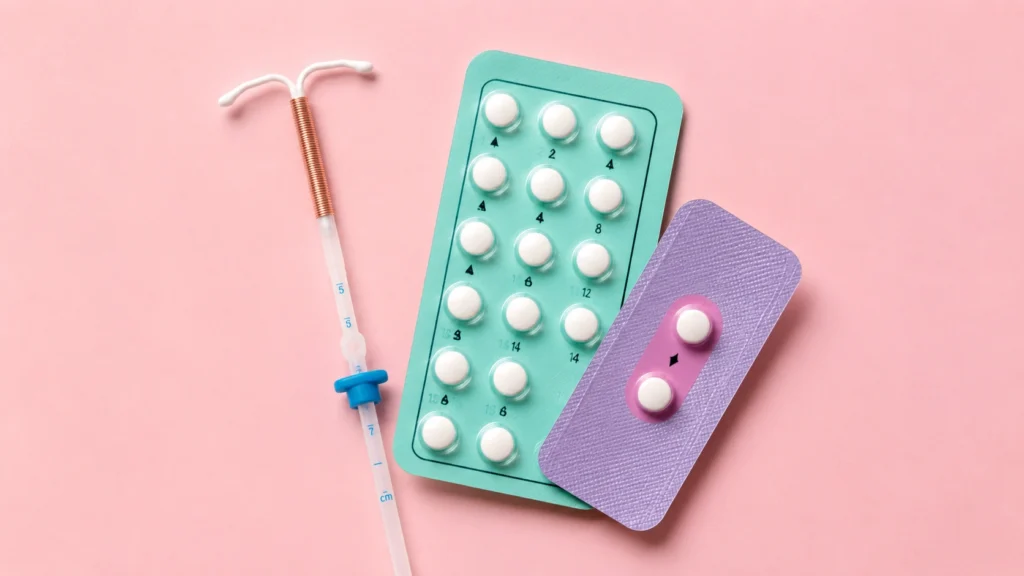
A hormonal IUD is a small device placed inside the uterus that releases a progestin. Depending on the specific device, it can provide contraception for several years.
The biggest advantage is convenience. You do not have to remember a pill every morning or think about contraception every time you have sex.
But there is another reason I find hormonal IUDs particularly interesting for women in their 40s: menstrual bleeding.
Perimenopause can sometimes bring heavier or more unpredictable periods. A hormonal IUD can significantly reduce menstrual bleeding, and some women eventually experience very light periods or no bleeding at all.
For a woman who tells me, “My family is complete, I want reliable contraception, and my periods are becoming heavier,” a hormonal IUD is often worth discussing.
Irregular spotting can occur, particularly during the first few months, and insertion may be uncomfortable. Still, for many women it provides an excellent combination of effectiveness, convenience, and menstrual control.
2. Copper IUD
The copper IUD is another highly effective, long-acting method.
Its biggest advantage is that it contains no hormones.
For women who want reliable contraception but prefer to avoid hormonal methods, this can make it one of the most attractive birth control options for women over 40.
However, there is an important downside.
Copper IUDs can make menstrual bleeding heavier or periods more painful, especially after insertion. Because some women already develop heavier periods during perimenopause, this should be considered carefully.
If a woman already has heavy menstrual bleeding or anemia, I would want to discuss whether another method might suit her better.
3. Progestin-Only Pill
The progestin-only pill is an estrogen-free oral contraceptive.
It can be useful for women who want to continue using a pill but for whom estrogen may not be appropriate.
This becomes increasingly relevant after 40 because cardiovascular risk factors, hypertension, smoking, migraines, and other medical conditions need to be considered before prescribing estrogen-containing contraception.
The main disadvantage is that the pill needs to be taken consistently, and irregular bleeding may occur.
For women who prefer oral contraception and need or want to avoid estrogen, however, it can be a practical option.
4. Contraceptive Implant
The contraceptive implant is a small flexible rod placed under the skin of the upper arm.
It releases a progestin and provides highly effective contraception for several years.
I like this option for women who want something that is reversible but requires very little daily attention.
Once the implant is placed, there is no pill to remember.
The main issue I discuss with patients is bleeding. Menstrual patterns can become unpredictable. Some women stop having periods, while others experience irregular or frequent spotting.
If having a predictable menstrual cycle is very important to you, this is worth considering before choosing the implant.
5. Combined Birth Control Pill
Many women assume they must automatically stop the combined birth control pill when they turn 40.
That is not necessarily the case.
For appropriately selected healthy women, combined hormonal contraception may still be an option during the 40s.
Combined pills contain estrogen and a progestin. Besides preventing pregnancy, they may make periods more predictable, decrease menstrual bleeding, reduce menstrual pain, and sometimes help with symptoms occurring around perimenopause.
However, estrogen-containing contraception is not appropriate for everyone.
This is where your medical history becomes extremely important.
Smoking, high blood pressure, migraine with aura, previous blood clots, certain cardiovascular conditions, and combinations of cardiovascular risk factors can make combined hormonal contraception inappropriate or less desirable.
If you have been taking the same pill for many years, I recommend reviewing it with your healthcare professional after 40 rather than assuming you should either continue it indefinitely or stop it simply because of your age.
6. Vaginal Ring and Contraceptive Patch
The vaginal ring and contraceptive patch are alternatives to taking a combined pill every day.
Both contain estrogen and a progestin, so the medical considerations are generally similar to those for combined oral contraception.
Their advantage is convenience.
For women who frequently forget pills but remain appropriate candidates for combined hormonal contraception, these methods can be useful alternatives.
However, because they contain estrogen, they still require assessment of cardiovascular and clotting risk factors.
7. Birth Control Injection
The contraceptive injection is another estrogen-free method.
It is generally administered every few months and can be convenient for women who do not want a daily contraceptive.
Some women eventually experience lighter periods or no periods.
However, prolonged use of the injection requires particular consideration as women approach menopause because of concerns related to bone mineral density.
For that reason, I believe it is important to periodically reassess whether the injection remains the best option rather than simply continuing it for years without reviewing alternatives.
8. Condoms
Condoms remain an important contraceptive option at any age.
They have one major advantage that hormonal contraception and IUDs do not: they can help reduce the transmission of sexually transmitted infections.
This is particularly important if you have a new partner.
The disadvantage is that condoms depend heavily on correct and consistent use and are less effective at preventing pregnancy with typical use than highly effective long-acting methods such as IUDs and implants.
For some women, condoms alone may be enough. Others may prefer to combine condoms with another contraceptive method.
9. Permanent Contraception
For women who are completely certain they do not want any future pregnancies, permanent contraception can also be considered.
Female permanent contraception generally involves blocking or removing the fallopian tubes.
Bilateral salpingectomy, in which both fallopian tubes are removed, may be discussed as a permanent contraceptive option. Removal of the tubes may also reduce the future risk of certain ovarian cancers.
A partner’s vasectomy is another permanent option and is generally a less invasive procedure than female sterilization.
The important word here is permanent.
I recommend considering permanent contraception only when you are confident that your family is complete and you do not want the possibility of a future pregnancy.
What Is the Best Birth Control for Women Over 40?
When patients ask me this question, my answer is usually: it depends on what you need from your contraception.
If you want something highly effective and low maintenance, an IUD or implant may be worth considering.
If you have heavy periods, a hormonal IUD may offer the additional advantage of reducing menstrual bleeding.
If you want hormone-free contraception, the copper IUD or barrier methods may be appropriate.
If you prefer a pill but want or need to avoid estrogen, a progestin-only pill may be an option.
And if you are healthy and have no important contraindications to estrogen, combined hormonal contraception may still be considered during your 40s.
The best birth control options for women over 40 are therefore not necessarily the same for every woman.

My Approach as a Doctor
When I counsel a woman about contraception, I try not to make the conversation simply about preventing pregnancy.
I ask: What matters most to you?
Do you want another child? Are your periods becoming heavier? Do you want to continue having monthly bleeding? Do you forget pills easily? Are you comfortable having an IUD inserted? Do you want to avoid hormones?
Then I look at the medical side.
Blood pressure, smoking, migraine history, blood clot history, medications, cardiovascular risk factors, and other medical conditions can completely change the recommendation.
For example, a healthy 41-year-old nonsmoker looking for better cycle control may have very different choices from a 44-year-old woman who smokes and has hypertension.
That is why I believe good contraception is not about finding the most popular method. It is about finding a method that is safe, effective, and compatible with your lifestyle and priorities.
Can Birth Control Help During Perimenopause?
Yes, certain methods can offer benefits beyond contraception.
Hormonal contraception may help control irregular or heavy periods, and some combined methods may help selected women with certain perimenopausal symptoms.
However, birth control is not the same thing as menopausal hormone therapy.
As you move closer to menopause, your contraceptive needs and symptom management may need to be reviewed separately.
When Can You Stop Birth Control?
Do not stop contraception simply because your periods have become irregular.
During perimenopause, you may go several months without a period and then ovulate again.
Menopause is generally identified retrospectively after a sufficient period without natural menstruation, but hormonal contraception can complicate this because some methods cause irregular bleeding or stop periods altogether.
The appropriate time to discontinue contraception depends on your age, the method you are using, and your individual circumstances.
If you are approaching menopause, discuss this with your healthcare professional rather than using your menstrual pattern alone to decide.
Final Thoughts About Birth Control Options for Women Over 40
There are many safe and effective birth control options for women over 40, but this is also an age when choosing contraception deserves more individualized attention.
Your fertility may be declining, but pregnancy can still happen. At the same time, your menstrual pattern, blood pressure, cardiovascular risk, migraines, smoking status, bone health, and future pregnancy plans can influence which method is best for you.
For many women, an IUD or implant offers excellent long-term contraception. Others may prefer a progestin-only method, combined hormonal contraception, condoms, or permanent contraception.
The most important thing I want you to take away from this article is that turning 40 does not automatically mean you have to stop birth control or switch to a specific method.
Your contraception should evolve with your health, your body, and your life.
If you are still using the same contraception you started years ago, your 40s are a good time to have a contraceptive review with your doctor or gynecologist.
Sometimes the method you already use remains a great choice. Other times, a different option may provide better contraception, fewer side effects, or additional benefits during perimenopause.
Frequently Asked Questions About Birth Control Options for Women Over 40
What is the best birth control after 40?
There is no single best method for everyone. Long-acting options such as hormonal IUDs, copper IUDs, and implants are highly effective, while the best choice depends on your health, bleeding pattern, preferences, and future pregnancy plans.
Is it safe to take birth control pills over 40?
Yes, birth control pills can be safe for many healthy women over 40. However, combined pills containing estrogen require careful assessment, particularly if you smoke or have hypertension, migraine with aura, cardiovascular disease, or an increased risk of blood clots.
Is 40 too old to be on birth control?
No. Being 40 does not mean you are too old for contraception. Pregnancy can still occur during perimenopause, and age alone does not exclude most contraceptive methods. Your individual health risks are more important when choosing a method.
Do I need birth control if my periods are irregular?
Yes, if pregnancy is still possible and you do not want to conceive. Irregular periods during perimenopause do not necessarily mean that ovulation has stopped.
Which birth control is best for heavy periods after 40?
A hormonal IUD is often worth discussing because it provides highly effective contraception and may significantly reduce menstrual bleeding.
Is an IUD suitable after age 40?
For many women, yes. Both hormonal and copper IUDs may be used during the 40s when medically appropriate. The choice often depends on factors such as bleeding patterns and whether you prefer hormonal or non-hormonal contraception.
What is the best contraception for perimenopausal women?
The best contraception depends on individual needs. A hormonal IUD can be particularly useful for women who also experience heavy or painful periods, while IUDs, implants, progestin-only methods, and combined hormonal contraception in medically eligible women are other options.
Medically Written & Reviewed: This article was written by Dr. Soumia, based on current medical evidence and trusted healthcare sources, with a focus on providing accurate, clear, and reliable health information.
To ensure this guide is accurate and informative, I’ve drawn on trusted medical insights from WebMD and Walnut Hill OBGYN alongside established contraceptive guidance.
Medical Disclaimer: This article is intended for general educational purposes and does not replace personalized medical advice, diagnosis, or treatment. The safest contraceptive method depends on individual health conditions, medications, risk factors, and reproductive goals. Always discuss your personal contraceptive needs with a qualified healthcare professional.